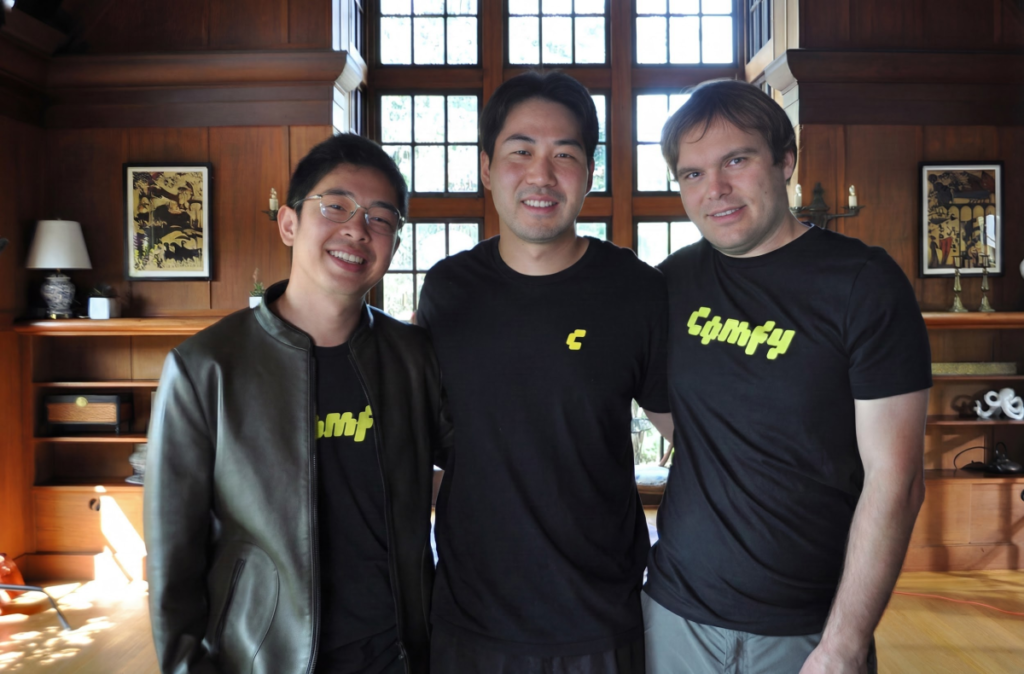

ComfyUI, the node-based interface that lets you actually tweak every damn parameter of an AI image or video pipeline, just closed a $30 million round. The valuation? Half a billion dollars.
That’s not unicorn territory yet, but for a tool that started as a niche alternative to the polished, one-click UIs like Midjourney or DALL-E, it’s a serious signal. The round was led by some familiar names in the AI infrastructure space—I won’t bore you with the cap table—but the message is clear: the market for granular control is real and growing.
What ComfyUI does differently is pretty straightforward. Instead of giving you a text box and hoping for the best, it lays out the entire generation process as a visual graph. You connect nodes for model loading, prompt conditioning, sampling, upscaling—everything. It’s like wiring up a modular synthesizer, but for generating images instead of sound.
This approach has been around for a while. Automatic1111’s WebUI did something similar for Stable Diffusion, but ComfyUI took it further with a cleaner visual language and better performance. The trade-off is a steeper learning curve. You won’t be generating your first image in 30 seconds like you would with Midjourney. But once you get the hang of it, the level of control is unmatched.
I’ve been using ComfyUI for about a year now, mostly for video generation experiments. The ability to chain multiple models, control noise schedules per frame, and inject custom LoRAs at specific stages of the pipeline is something you just can’t do in any other consumer-facing tool. It’s not for everyone, and that’s fine.
The $30 million will likely go toward making the onboarding less painful—better documentation, pre-built workflows, maybe a cloud-hosted version so people don’t have to wrestle with CUDA dependencies on their own machines. The team has already hinted at a more curated template library, which I think is a smart move. Give new users a few well-designed starting points, then let them dive deeper as they get comfortable.
What’s interesting is the timing. We’re seeing a broader pushback against the “black box” approach in generative AI. Creators want to know why an image turned out the way it did, and they want the ability to fix specific issues without regenerating from scratch. ComfyUI gives them that. It’s not just a tool; it’s a philosophy.
Of course, there are downsides. The node-based interface can get messy fast. A complex workflow with 50+ nodes looks like a plate of spaghetti, and debugging it is a pain. The community has built some helpers—grouping nodes, collapsing subgraphs—but it’s still not as clean as a traditional UI. And performance-wise, you’re trading speed for control. Running a multi-stage pipeline with multiple models is slower than a single pass through a monolithic model.
Still, for the kind of work that demands precision—commercial video production, architectural visualization, scientific imaging—ComfyUI is becoming the standard. The valuation reflects that. Half a billion is a lot for a tool that most casual users have never heard of. But the people who know it, really know it.
I’m curious to see how they spend the money. If they can lower the barrier to entry without dumbing down the tool, they could pull in a much larger audience. If they go the other way and double down on the power-user experience, they’ll keep their core community happy but might miss the growth opportunity. Either way, it’s a bet on the idea that creators want more control, not less. And I think that’s a good bet.
Comments (0)
Login Log in to comment.
Be the first to comment!