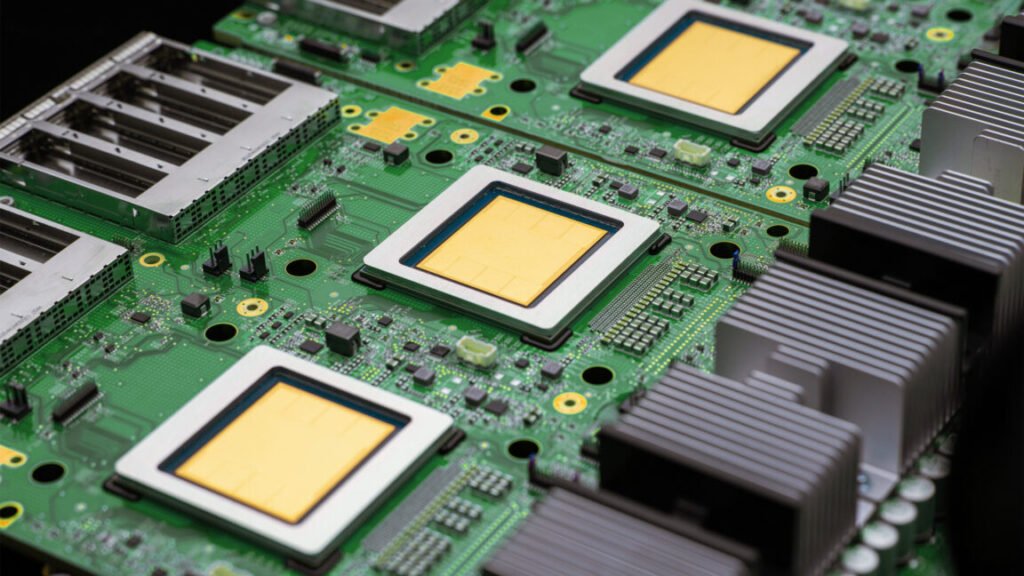

Google’s been doing its own thing on the hardware front for a while now. While everyone else is fighting over Nvidia’s latest GPUs like it’s Black Friday for data centers, Google’s been quietly building out its custom Tensor Processing Units (TPUs). Last year we got the seventh-gen Ironwood, and now the eighth-gen is here. But this isn’t just another iteration with a faster clock speed.
Google’s betting that the “agentic era”—where AI systems act more autonomously, making decisions and taking actions on their own—demands a fundamentally different approach to hardware. So they’ve split the TPU into two distinct flavors: the TPU 8t for training and the TPU 8i for inference.
The TPU 8t is aimed squarely at the training phase. If you’ve ever watched a frontier model go through its paces, you know training takes months. Google claims the 8t can shrink that down to weeks. That’s a big deal if you’re trying to iterate quickly on model architecture or scale up to something truly massive.
On the flip side, the TPU 8i is built for inference—the part where the trained model actually does something useful, like powering a chatbot or analyzing your data. Google’s argument is that agentic workloads are fundamentally different from the batch inference of earlier AI systems. Agents need low latency, high throughput, and the ability to handle unpredictable, real-time requests. The 8i is tuned for that.
I think this split makes a lot of sense. Training and inference have always had different requirements, but most hardware tried to be a jack-of-all-trades. Google’s finally admitting that specialization is the way to go, especially when you’re talking about agents that need to respond in milliseconds.
Of course, this is Google’s ecosystem. If you’re not on Google Cloud, you’re not touching these chips. But for those who are, this could mean faster model development and more responsive AI services. The real question is whether this will push Nvidia to offer more specialized hardware, or if the market will just keep buying whatever Nvidia puts out.
Either way, Google’s making a clear statement: the agentic era isn’t just a software shift—it’s a hardware shift too.
Comments (0)
Login Log in to comment.
Be the first to comment!